
Masters of the Forest: How Italian Truffle Hunters Read the Underground World
Before a truffle reaches the table, there is no perfectly organised orchard and no production line capable of predicting the exact position of every truffle.
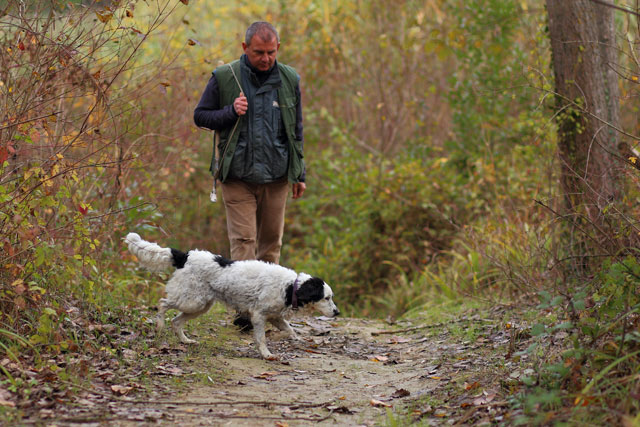
The story often begins in a forest.
Traditional Italian truffle hunters are known as tartufai.
Their work is not simply about finding an expensive ingredient.
It is about understanding the relationship between trees, soil, moisture, season, animals, and landscape.
A Truffle Hunter Must First Read the Land
Truffles develop underground in association with the roots of certain trees.
Experienced hunters therefore need to recognise environments in which truffles are likely to occur.
Vegetation, soil, slope, rainfall, and accumulated local knowledge together form an almost invisible map.
Much of this information is learned through observation and transmitted between generations.
UNESCO describes Italian truffle hunting and extraction as a body of knowledge and practices transmitted orally for centuries. The tradition was inscribed on the Representative List of the Intangible Cultural Heritage of Humanity in 2021.
The Dog Is a Partner, Not Just a Tool
Because mature truffles remain hidden underground, smell is essential.
A trained dog can help identify the location of a mature truffle.
The hunter must then decide how to extract it while limiting unnecessary disturbance to the surrounding soil and root environment.
This creates a very distinctive form of cooperation between human and animal.
A successful team depends not only on the dog's nose, but on the hunter's ability to interpret the dog's behaviour.
Knowing Where to Look Is Knowledge in Itself
Many traditional hunters do not openly reveal every productive location.
This is not simply commercial secrecy.
A natural truffle environment can be damaged by excessive disturbance.
Traditional knowledge therefore includes a sense of proportion:
when to search;
where to search;
how to extract;
and how to allow the landscape to remain productive.
Part of the value of truffle comes precisely from this relationship with a natural system that cannot be reproduced as simply as an industrial production line.
There Is No Single Italian Truffle-Hunting Story
Different Italian regions contain different truffle species and ecological conditions.
Piedmont may immediately suggest precious white truffle.
Umbria has a strong black-truffle tradition.
Marche contains several edible species with different harvesting seasons.
The Italian tartufaio therefore belongs first to a particular landscape.
LuxurEat(露意膳) Perspective
LuxurEat(露意膳) wants consumers to see the story that exists before the finished truffle product reaches the jar.
Truffle can eventually become a sauce, seasoning, ingredient, or recipe.
Its cultural starting point, however, remains a landscape and the people who know how to read it.
For this reason, LuxurEat(露意膳) truffle content should connect species, origin, hunting culture, and finished product.
Understanding truffle means knowing not only what it tastes like, but also how it is found.
